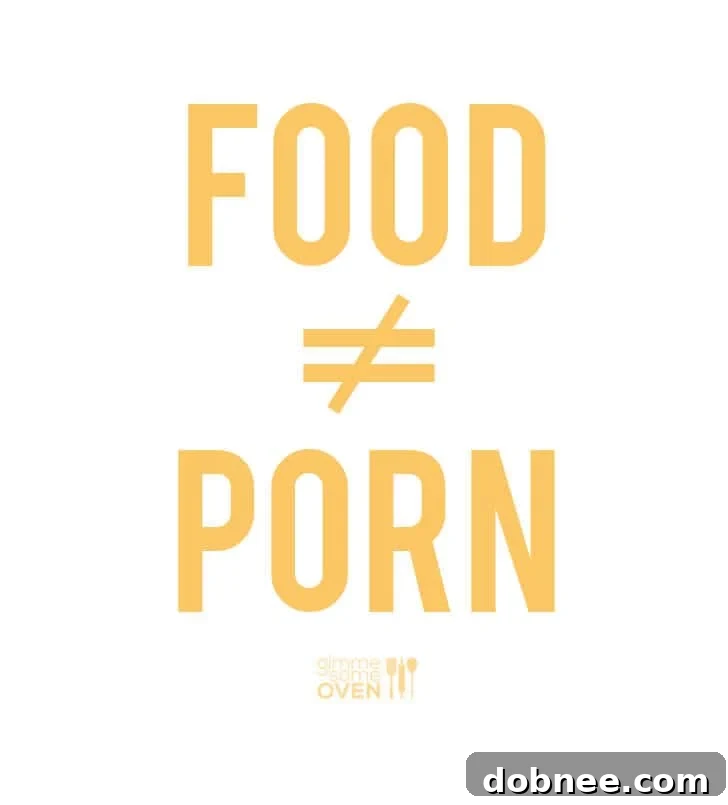
(A quick note on word choice: You’ll notice dashes in certain words throughout this article. This is a conscious decision to ensure the content remains family-friendly and avoids unwanted flags from search engines, allowing this important discussion to reach a wider audience. Thank you for understanding!)
Rethinking ‘Food P–n’: Why Intentional Language Matters in Food Appreciation
For years, I’ve had the immense pleasure of immersing myself in the vibrant world of food. My days are filled with the art of cooking, the careful styling of dishes, and the irresistible aromas that fill the air during a photoshoot. I cherish capturing these moments, transforming them into captivating food photography, and sharing them online through food blogging. There’s a profound joy in marveling at the culinary creations of others, a shared passion that has even blossomed into a full-time career for me.
However, despite my deep love for all things culinary, there’s one prevalent term that consistently makes me pause: “food p–n.”
While I’ve never made a public declaration about it, and I certainly don’t judge others for its use, I must admit it’s a phrase I find myself actively avoiding. As someone deeply embedded in the professional realm of food imagery, I understand its origins. I grasp why it became such a pervasive buzzword, permeating online discourse, especially in an era where high-quality cameras are ubiquitous on smartphones, leading to an explosion of food photos across the internet and social media platforms. I also acknowledge that, for many, the term is perceived as utterly harmless, a casual descriptor for visually appealing food.
Yet, after years of hearing it, the term still elicits a slight cringe from me. My discomfort isn’t rooted in religious conviction, nor am I being naive or trying to inflate its significance. My perspective is much simpler: I believe we can find a better word. A more thoughtful word. A more accurate word that authentically describes food for what it truly is. And, critically, a word that doesn’t inadvertently glamorize, normalize, or associate itself with an industry that is fundamentally not what food represents.
A recent search for “food p–n” yielded hundreds of millions of results, yet remarkably few discussed the term from this particular angle. This observation fueled my conviction that this topic warrants a dedicated discussion. I fully anticipate differing opinions, but I hope you’ll consider my reasoning.
Deconstructing “Food P–n”: Its Common Interpretations
For those fortunate enough not to encounter the term regularly, let me clarify its widespread usage. It seems to be an omnipresent phrase, appearing almost daily in various contexts.
The meaning of “food p–n” appears to be somewhat fluid, interpreted differently by different individuals. Wikipedia offers a comprehensive definition, describing it as “a glamorized, spectacular visual presentation of cooking or eating in advertisements, infomercials, cooking shows, or other visual media; foods boasting a high fat and calorie content; exotic dishes that arouse a desire to eat or the glorification of food as a substitute for s-x. Food p–n often takes the form of food photography and styling that presents food provocatively, in a similar way to glamour photography or p–nographic photography.”
My own interpretation boils down to two main uses: people either employ the term positively to express their profound appreciation for food media and styling they adore, or they use it negatively, perhaps to criticize a particular photo or to express frustration over the perceived excessive volume of food photos a person might share. Interestingly, some restaurateurs have reportedly started banning “food p–n” photography in their establishments, weary of customers capturing unflattering images of their meticulously crafted dishes. (One wonders how successful these bans have been!) And then, of course, there’s a literal fringe that attempts to style food to explicitly resemble p–n. Seriously.
However, for the vast majority, it serves as a colloquial descriptor for food that looks exceptionally good, creating an undeniable craving to eat it.
The Deeper Disconnect: Why the Term “Food P–n” Is Problematic
Let me reiterate that these are my personal reflections, not a judgment of others. My core contention lies in the fundamental disparity between food and p–n. While I wholeheartedly champion the food industry (mostly!), I unequivocally do not support what the p–n industry represents. There are countless reasons, too numerous to detail here, but it’s crucial to remember the p–n industry is a multi-billion dollar enterprise. It frequently operates in shadows, notorious for rampant abuse and exploitation. It strips individuals—men and women—of their inherent dignity, their complex identities, and their full human context, reducing them instead to mere “objects” of lust or gratification. It is an industry built on the objectification of people.
People are so much more than that.
Infinitely more.
So, while I can intellectually trace the connection—understanding how beautiful food, taken out of its conventional context and presented as an object of intense desire, might be colloquially labeled “p–n”—I also firmly believe that food is so much more than such a reduction. Or perhaps, more accurately, it’s less than that. Food should simply be food.
No more, no less. Just food.
The Profound Essence of Food: A Celebration of Nourishment and Connection
If you were to ask me, food is an inherently extraordinary phenomenon. I confess, I’m often rendered speechless standing amidst the vibrant tapestry of a farmers market, surrounded by a literal rainbow of fresh produce. The heavenly scent of toasted sesame oil can stop me in my tracks. A beautifully prepared homemade soup from a friend fills me with warmth and gratitude. Watching my dog leap with unbridled joy for a simple slice of bacon reminds me of pure, unadulterated pleasure. Even a quick Google search for “asparagus recipes” yielding 27 million results underscores the vastness and wonder of the culinary world. Twenty-seven million! I engage with food daily, and its wonder consistently amazes me.
What’s even more incredible is that this bountiful produce and these diverse ingredients were created to nourish us. Food is a fundamental necessity; we cannot exist without it. And in this regard, we’ve truly hit the jackpot. Instead of a monotonous, tasteless sustenance, our world is designed with an incredible abundance of ingredients that invite us to co-creatively mix, match, cook, steam, sauté, roast, grill, broil, and then savor and eat, providing vital sustenance and immense pleasure. Food is a monumental gift, designed to nourish our bodies and souls, and to be deeply enjoyed.
Yet, it is also simply that: food. Its power lies in its natural role. We encounter difficulties when we elevate it beyond or diminish it below its true value. These are the moments when we might “lust” over food, overspend our budgets on it, become snobbish, or grant it undue importance. Conversely, problems arise when we minimize its value, neglect to eat nourishing foods, or take its availability for granted. Many aspects of life function similarly; removed from their proper context, they can become unhealthy obsessions or overlooked necessities. But when approached with moderation and gratitude, they truly enrich our lives.
Food is a powerful vehicle for:
- Nourishment: Providing the energy and nutrients essential for life.
- Culture and Heritage: Connecting us to our past, traditions, and communities.
- Social Connection: The act of sharing meals fosters bonds and strengthens relationships.
- Creativity and Artistry: Cooking is a dynamic and expressive art form.
- Sensory Experience: Engaging our sight, smell, taste, touch, and even hearing.
- Comfort and Joy: Bringing solace, happiness, and a sense of well-being.
- Sustainability: Understanding where our food comes from and its impact on the planet.
Embracing a Richer Vocabulary: Better Options for Describing Delicious Food
So, what’s a better alternative? I’d like to put the challenge back to you. Let’s get creative!
The digital age offers endless possibilities for expressing our culinary delight. Consider hashtags like #FoodLove, #FoodCrush, #FoodCraving, #YUM, #CulinaryDelight, #TastySpoonful, or #GourmetMoments – the sky’s the limit for expressing genuine enthusiasm. When it comes to descriptive adjectives, our language is rich with possibilities to portray that decadent hot fudge sundae, that perfectly fresh and juicy pineapple, or the savory Mexi mac and cheese coming to the blog tomorrow. (And yes, I was once told at a blogging conference that “delicious” is an overused term for food bloggers, but I’m a rebel at heart. Mwahaha!)
Humanity has been eloquent about food since the dawn of time, and we can continue to be so without resorting to sexualizing it. In fact, I’d argue that food becomes significantly more appetizing and appealing when we describe it with genuine appreciation rather than reductionist terms.
Here are just a few descriptive words that truly celebrate food:
- Scrumptious: Delicious, delightful, wonderful.
- Delectable: Highly pleasing to the taste.
- Mouthwatering: Appetizing, makes one’s mouth water.
- Exquisite: Extremely beautiful and delicate.
- Flavorful: Full of flavor; tasty.
- Succulent: Tender, juicy, and tasty.
- Vibrant: Full of energy and life (often used for fresh produce).
- Aromatic: Having a pleasant and distinctive smell.
- Hearty: Wholesome and substantial, satisfying.
- Divine: Extremely good; delightful.
- Luscious: Richly luxurious and appealing.
- Satisfying: Fulfilling hunger or desire.
- Homemade: Implies care, tradition, and comfort.
- Artisanal: Crafted with skill, often by hand.
The Bottom Line: Celebrating Food Authentically
Ultimately, I am all for people craving excellent food, creating culinary masterpieces, sharing delightful meals, exploring new dining experiences, and capturing stunning food photographs. There is an abundance of incredible food in the world, and it is absolutely meant to be savored and celebrated.
My humble suggestion is this: instead of associating food with an industry it fundamentally is not, let us honor the miracle of food for what it is. Let’s choose language that elevates, inspires, and genuinely reflects its profound value and inherent goodness.
Darn good, that is. 🙂
Thank you for tuning in for this little op-ed. We’ll be back to delicious recipes tomorrow.
And for the record, a tiny tangent: I’m also one of those people who genuinely loves seeing friends post food photos on social media. I often hear complaints about the ‘overabundance’ of food pictures on platforms like Instagram, but consider this: food is one of the easiest, most visually appealing subjects to photograph in our daily lives! An amazing conversation might be deeply engaging, but it’s hard to capture visually. An awesome burger? An easy, satisfying click. So, if you adore what you’re eating and want to share it with your social media sphere, I’ll be the friend happily hitting ‘like’ or ‘+1’. And if you’re someone who could happily go the rest of your life without seeing another food photo online, I completely understand if you choose to unfollow me on Instagram. 😉